
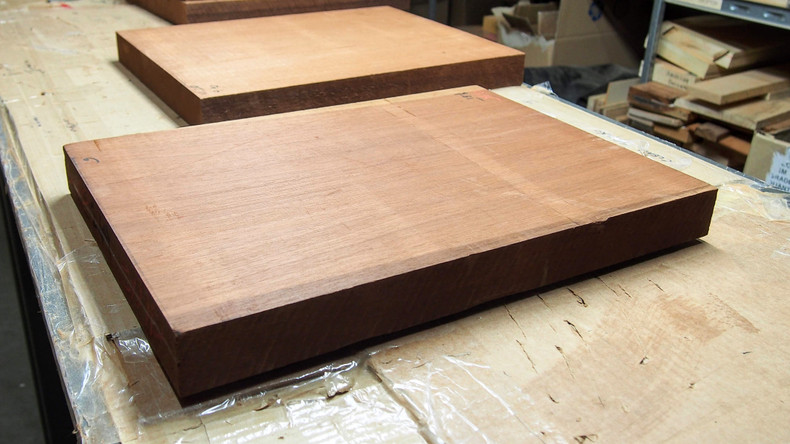
When we talk about wood it appears different from each perspective someone has. Each person has their own personal experiences which colors their viewpoint. Ours is a unique view.
When you work with the mills they only see the wood from the lumber standpoint. Small differences in grade and density doesn't impact them. And the volume they see results in large generalities.
When you work with the builders/factories they don't really understand the volume side of it. And they work with each piece for so long that they can't see the forest while surrounded by trees, so to speak.
This leaves us right in the middle. We take the wood right from the source all the way to the build. This gives us the perfect place to see both large volumes and individual builds. That is one of the reasons people keep coming back to us. The knowledge that we bring to each part of the equation.
Now lets take a few moments to review some electric guitar body blanks and the differences. We will be looking at Size, Density, Grade, and Materials.
Size:
Sizing a block is pretty easy. Just measure the length, width, and thickness. If you use inches then follow this formula to get a board foot calculation. (Length x width x thickness) / 144 = BF.
From this we have set some standards that we see are averages. But remember each build is unique and we always recommend at a minimum of 1/4" to 1/2" oversize the block to you build on each side. (example. guitar is 17" long, the wooden block should be 17 1/2" long. This would result in 1/4" extra on the top and bottom)
- Standard Guitar = 13.25" x 19" x 1.75" ----------------(3.06 bf)
- Bass Guitar = 14" x 22" x 1.75" --------------------------(3.74 bf)
- Narrow Guitar = 12.75" x 19" x 1.75" -------------------(2.94 bf)
- Wide Guitar = 15" x 20" x 1.75" --------------------------(3.65 bf)
- Thick Guitar = 14" x 20" x 2" ------------------------------(3.89 bf)
Density:
Tree are living, breathing, organisms. As a result even within the same species there can be large differences due to the trees individual growing conditions, soil nutrients, water supply and it's own DNA.
The density of the wood is determined by the weight of the board divided by the board footage calculation
weight of the board in lbs / toal bf = density
example: 9 lbs / 3.06 bf = 2.94 lbs/bf
Range of Density in Wood:
The density of wood can range from feather-light, to heavier than some metals. Body woods fall from 1.55 lbs/bf (the lightest I have ever calculated) up to over 5 lbs/bf (extremely heavy). Most fall between 2.75 lbs/bf and 3.2 lbs/bf.
Using the sizes (see sizing guidelines) a standard guitar block on the average will be from 8.4 lbs to 9.8 lbs. If it is a bass guitar block then from 10.29 lbs to 11.97 lbs. So the 8.4 lbs block is the same as 10.29 lbs for density. Only the size has changed.
This is why density is the most important thing you can look at when you are picking out a piece for your build. The size of the block can give the illusion of lightweight, only to find when you are finished that your new build is a bit overweight.
Materials:
Luthiers have been using a variety of woods form all over the wold since they starting making fine instruments, or even some mediocre ones. A few of them have really hit the mark when it comes to building electric guitars.
- Poplar- Lighter on average than the other popular body materials. Perfect for body wood that will have a top wood applied or will be painted.
- Ash - The classic sound that never gets old. Great looking grain patterns, white colors, and a good range in density makes this always a good choice.
- Mahogany - Strong warm sounds and the dark red colors have been making people fall in love with this wood for years.
- Alder - This wood takes colors and stains well, easy to work with, and good average density.
- Maple - Heavier than most of the other woods. It makes up for the weight with clear tones and a diverse amount of grain patterns.
Piece Count:
If all trees grew perfect, well I would make them square so they would be easier to stack. But they don't. I have checked.
When we make guitar body blocks we can make them in any number of pieces. Once they are glued up and dried they look great, sound great, and we don't have as much waste from the tree. Guitar bodies can be anywhere form 1 individual piece of wood up to any number of pieces. Not all wood is wide or thick enough to make the cut, but 2 or more might work.
If the glue joint is in the middle it is called a centerline glue joint. (2 pieces, and 4 pieces normally)
Body Piece counts
1 piece - The entire block is from one single piece of wood. This normally demands the highest price as ao few boards are wide and thick enough.
2 piece - This is from either 2 pieces of the same size with the joint in the middle (centerline) or 2 different size pieces where the joint is over to one side (off-centerline). These are great for paint or when a top wood is applied.
3 piece - Usually 3 pieces the same size are glued up. Because the center block is all one piece these bodies will sound the same as a 1 piece.
4 piece - 4 pieces the same size are glued up. These will also have a centerline joint up the middle of the guitar, thus sounding like a 2 piece. Saving the most money and using the most wood of the tree these bodies are the perfect choice of many new builders, students, environmentally conscious builders and many more.
Grades:
Although no industry standards have ever been set we use the following criteria for all of our body grades
1a - This grade has the body with cosmetic issues or some minor structural where body filler might be needed. Both faces could have more than 5 pin holes in pattern and non-uniform color. Perfect for test, student, or paint builds.
2a - One face will be uniform in color and less than 5 pin-holes in pattern. The 2nd face may have some issues. Great for builds where a top wood will be applied to one face.
3a - Top of the line, uniform in color, less than 5 pin-holes per face.
Conclusions
We hope that we have answered some of your questions when it comes to picking out a guitar body. Never be afraid to ask questions, we are here to help you along your journey from 1 guitar to 1000.